
Why Custom Millwork Changes Everything
There is a moment in almost every project where the conversation turns away from furniture and toward the walls themselves. A client will ask where the coats should go, or where twelve bottles of wine and the good glasses might live without cluttering a console, or how a bedroom with one awkward corner might still feel finished. The answer, more often than not, is millwork — cabinetry and shelving built for that exact wall, that exact room, rather than bought and hoped for. It is easy to think of built-ins as a practical afterthought, something for closets and laundry rooms. In practice, custom millwork is one of the most powerful tools available for making a room feel considered rather than furnished.
The difference shows up in proportion before anything else. A freestanding armoire, however beautiful, was designed for a showroom, not for a particular ceiling height or a particular slice of wall. Millwork is drawn to the room's own measurements, which means it can do something furniture never quite manages: disappear. It stops reading as an object and starts reading as architecture, as if the house had simply grown that way.
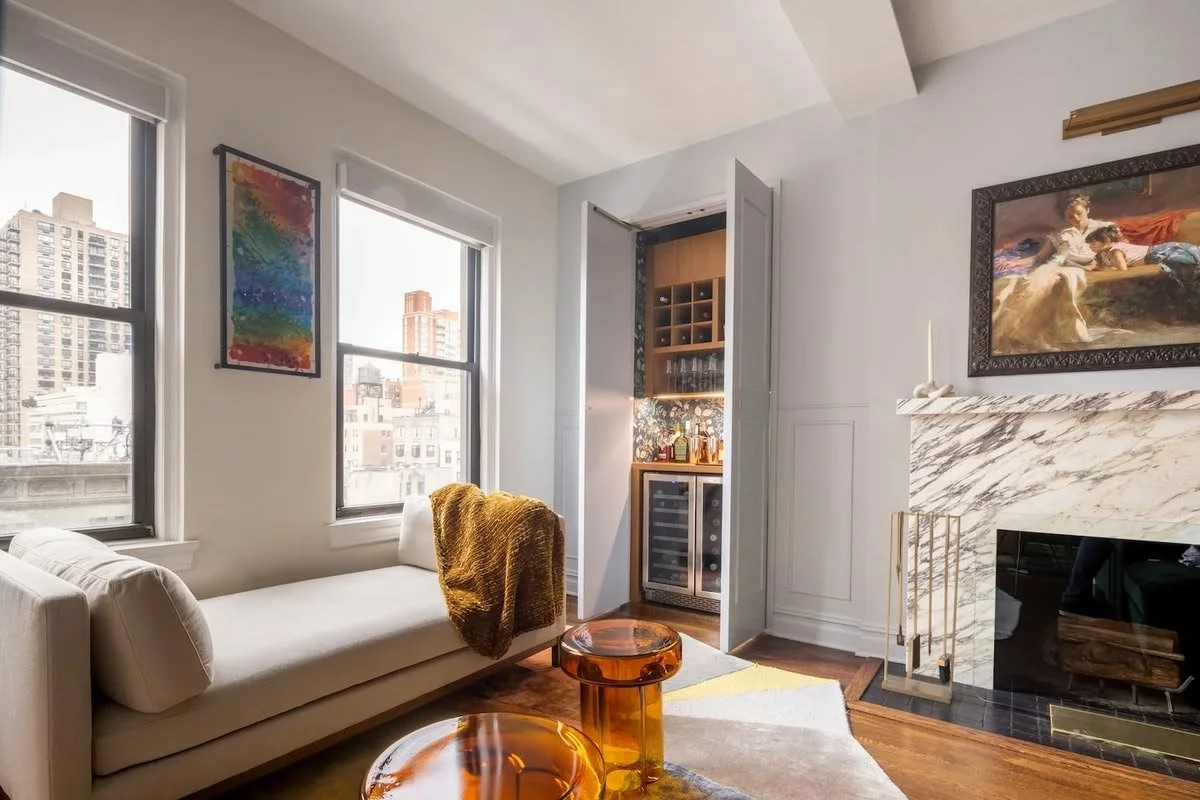
A recent living room in the Upper East Side, with the bar tucked into what reads as a simple closet door.
Take a bar. In one recent living room, what looks at first like a closet door beside the fireplace opens onto a small, fully outfitted bar — a wine fridge, a rack for bottles, open shelving for glassware, all faced in the same paneling as the rest of the room. Nothing about the closed door hints at what is behind it. That was the point. A bar cart or a freestanding cabinet would have asked for its own square footage and its own visual attention in a room that did not have room to spare. Building it into the wall let the function exist without asking the room to make space for it, and it meant the finishes inside — a bit of pattern on the back wall, warm wood shelving — could be a small private pleasure rather than a design statement the whole room had to accommodate.
A bedroom asks a different question, usually about scale. In a recent primary bedroom with a wall of exposed brick on one side, the opposite wall needed to hold a genuinely large amount of clothing without turning into a wall of anonymous doors. The solution was a run of wardrobes finished in a soft, matte grey, broken partway along by an open wood niche — a narrow bookshelf, in effect, holding a few objects and a stack of books rather than more hanging space. That small interruption does real work. It keeps a long wall from feeling like storage and lets it feel, instead, like a piece of furniture that happens to span the room. The warm wood of the open niche echoes the headboard and the floor, so the whole wall reads as considered rather than merely large.
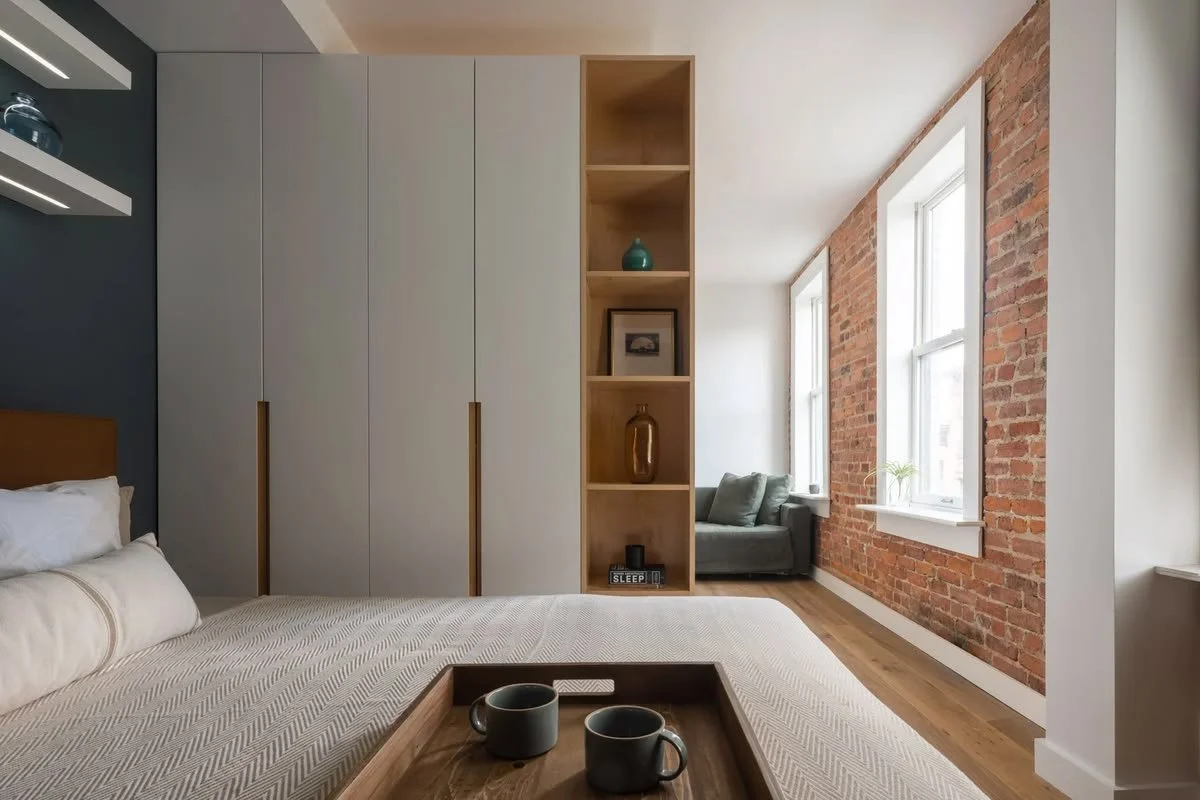
A Greenwich Village primary bedroom, wardrobe wall with an open niche for books and a few quiet objects
The most delicate use of millwork, though, is the one that has to sit beside something already there. A period fireplace with an original marble surround is not something to compete with. In a classic pre-war living room, the built-ins on either side of the mantle were painted to match the room's existing millwork rather than introduce a new material or a new tone, with open shelving above closed cabinets below — a proportion that has been used in these rooms for a century because it still makes sense. The goal was for the cabinetry to look as though it had always been there, holding books and small objects and the odd piece of pottery, rather than announcing itself as a recent addition. Fitted by hand until the seams between old plaster and new panel disappeared, it now reads as one continuous wall that happens to include a fireplace, rather than a fireplace with furniture arranged near it.
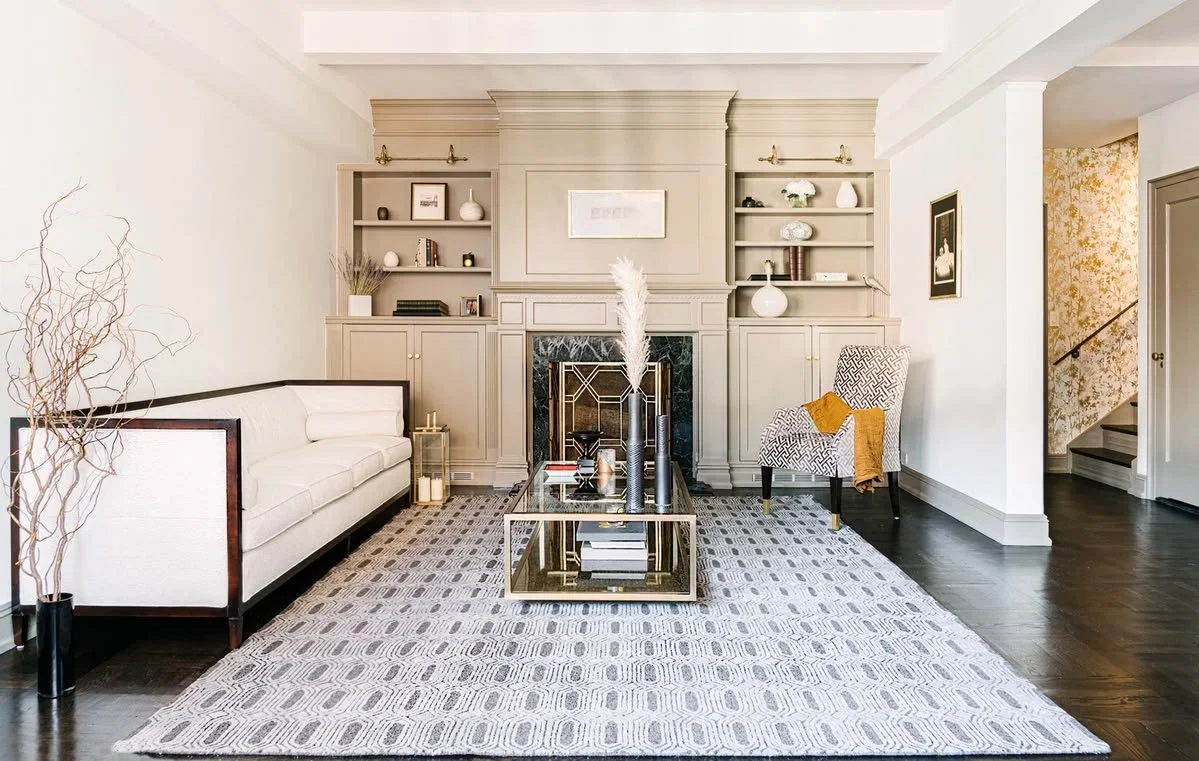
A classic pre-war living room in Murray Hill, built-ins fitted alongside the original mantle
What connects a hidden bar, a bedroom wardrobe, and a set of bookshelves beside a period mantle is not a look, exactly — the three rooms don't share a palette or a style. What they share is a certain respect for the room as it already is. Good millwork starts by asking what a space wants to keep — a run of brick, an old mantle, an awkward corner — and then builds around that instead of over it. That is closer to the European instinct behind most of this work: the belief that a room built to last should feel inevitable, as though no other arrangement was ever really possible.
It is why, walking into a room that isn't quite working, the first question is rarely what to bring in. More often it is what could be built in instead — quietly, permanently, and shaped for that one wall alone.