
Choosing Cabinetry That Will Stand the Test of Time
Cabinetry is rarely torn out because it has worn out. Walk through most gut renovations and the cabinets underneath the demolition are often still sound, still hung true, still closing the way they did the day they were installed. What sends them to the curb is almost never structural. It's that they never had good bones to begin with, or that they were chosen to look right in a photograph rather than to live well for the next fifteen years.
That distinction is worth sitting with before a single door style or paint color gets decided. A sofa or a rug can be swapped out on a whim without much cost to the room. Cabinetry cannot. It is fixed, expensive to redo, and present in every meal, every morning, every ordinary Tuesday spent in the kitchen. Choosing it well is less about finding the trend of the moment and more about finding material and craft honest enough to still feel right long after the moment has passed.
There is also a quieter argument in favor of restraint, one that has less to do with taste and more to do with values. A kitchen that gets redone every eight or ten years because the cabinetry started to feel dated is not just a financial cost. It's a lot of material, much of it good material, ending up in a landfill because it never had the chance to age into something worth keeping. Choosing cabinetry meant to last isn't only a design decision. It's a small, practical form of care for a home and for what leaves it.
Depth as a neutral, not a risk
Dark cabinetry has a reputation for being bold, even risky, the kind of choice that photographs beautifully but that homeowners talk themselves out of at the last minute in favor of something safer. In practice, a deep, saturated tone often ages more gracefully than a trend-driven pale one, provided the wood grain and the finish are honest rather than painted-on. A near-black stained oak or walnut reads as a neutral once you actually live with it. It recedes into the architecture instead of dating itself to a particular year, the way a very specific shade of pale gray or millennial-tinged white so often does once its moment has passed.
Part of what makes depth work over time is that it doesn't ask to be noticed. A cabinet finish that's too pale or too glossy draws the eye every time you walk into the room, and anything that draws the eye that consistently eventually starts to feel tired. A darker tone, done well, sits back. It becomes the frame for the room rather than the subject of it, which is exactly the kind of role a kitchen's largest surface should be playing.
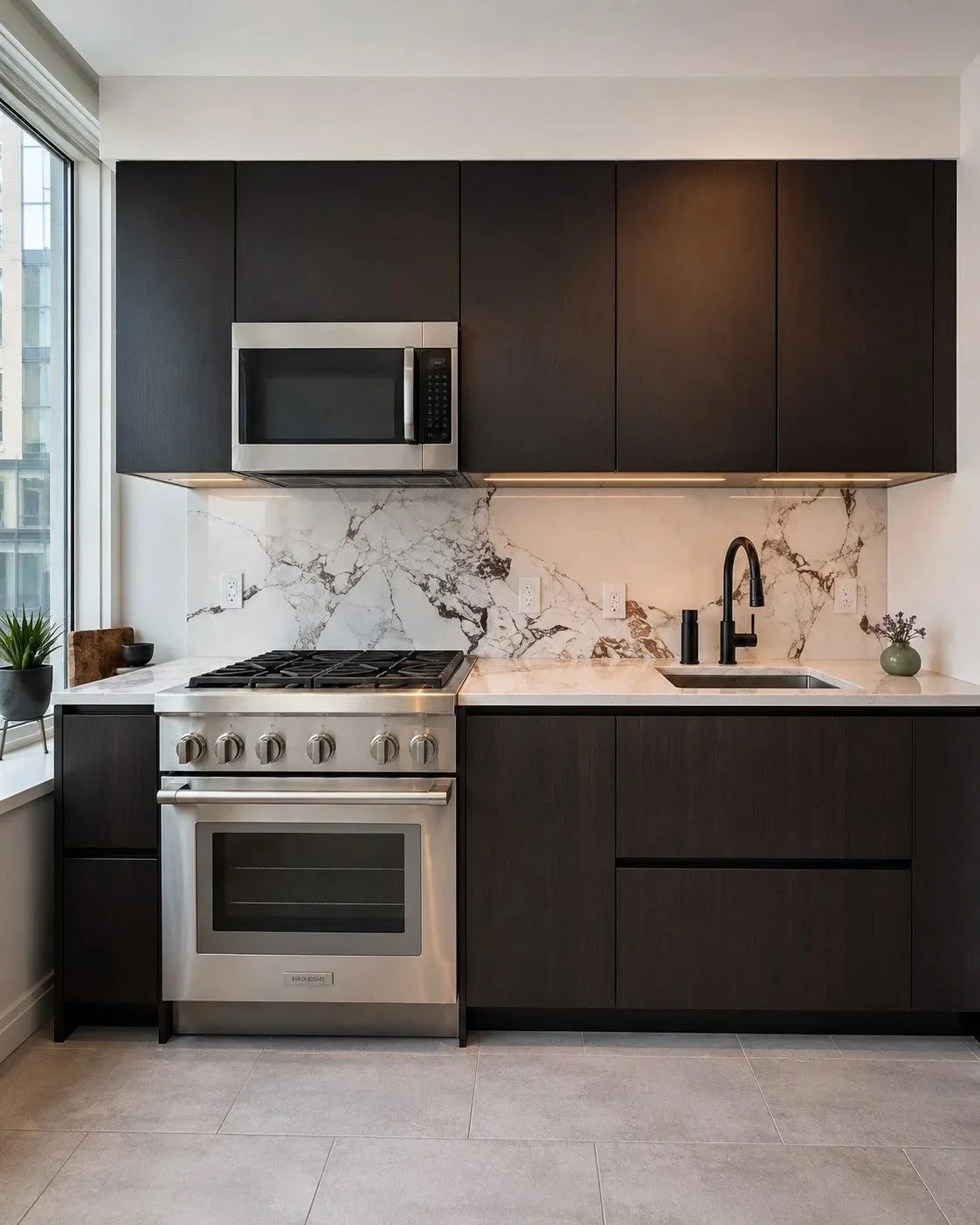
Hudson River Residence by Sara Mosele Interiors
In this kitchen, the depth of the cabinetry does the quiet work of grounding the space, while the marble behind the range and the warmth of the under-cabinet lighting keep it from ever feeling heavy. Nothing about the tone reads as a statement. It reads as a decision, made once, that doesn't need to be revisited. That is a good example of how tone, handled with restraint, becomes timeless rather than trendy.
Wood that's allowed to look like wood
At the other end of the same idea is cabinetry that simply lets its material speak. A light, natural-grain wood like white oak or ash, left close to its own color rather than pushed toward a heavy stain or a high-gloss finish, tends to feel just as current a decade from now as it does on installation day. The character comes from the wood itself, not from a treatment applied to disguise it, and character rooted in the material rather than the finish is what actually holds up over time.
This is also where the case for quality construction matters most, even if it isn't the most visually obvious choice on the page. Solid wood and true wood veneers age differently than the materials meant to imitate them. They can be touched up, refinished, lived with through decades of dinners and spills and small accidents, in a way that a synthetic surface simply can't. None of that needs to be explained to a homeowner standing in the room. It shows up on its own, in the way the light catches the grain, and in the fact that the cabinetry still looks like itself years later instead of looking like a slightly worn copy of itself.
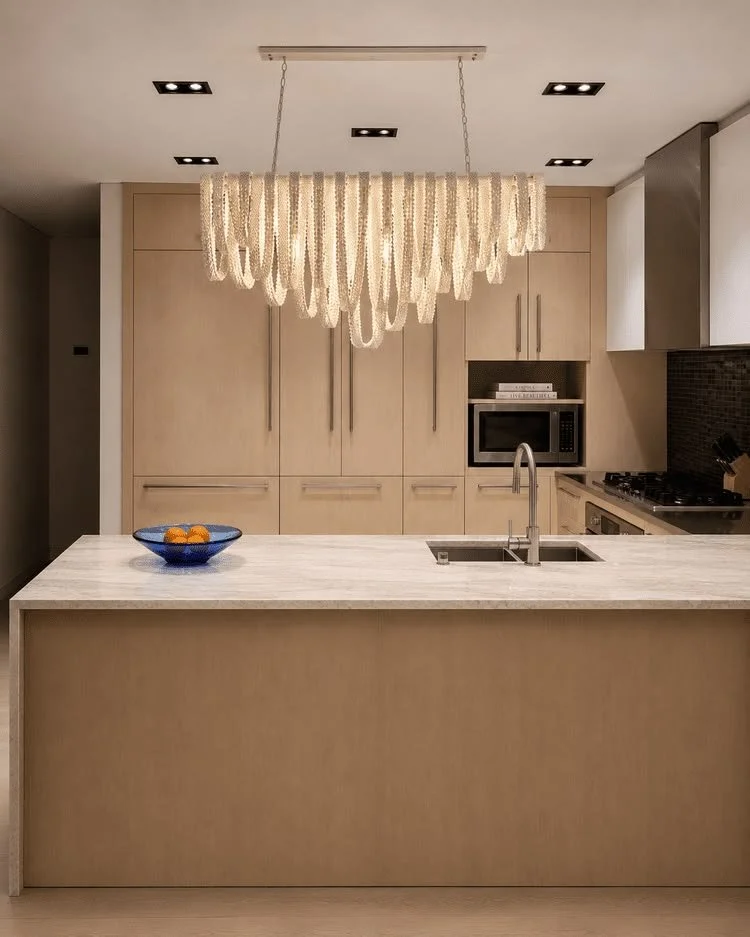
Kitchen in Chelsea by Sara Mosele Interiors
Here the cabinetry stays quiet on purpose, so the room can hold a chandelier this sculptural without feeling like it's competing with itself. The wood grain reads as warmth rather than pattern, which is exactly why it will still feel warm in twenty years, long after a bolder cabinet choice might have started to feel like a period piece.
Let the stone carry some of the story
One of the more useful decisions in a kitchen meant to last is deciding where the personality should live. If the cabinetry is quiet, a natural stone with real veining and movement can carry the visual interest instead, and it does so without ever needing to be redone. Stone with genuine character, chosen honestly rather than for how uniform it looks in a showroom sample, becomes more interesting with age, not less. It is one of the few materials in a home that a homeowner can fall more in love with over time rather than less.
This is also a useful way to think about where to spend and where to hold back. Cabinetry, by its nature, covers far more surface area than a countertop or a backsplash, which means a cabinet finish that starts to feel wrong is a much larger problem to fix than a stone that does. Letting the cabinetry stay calm and letting the stone do the talking isn't just an aesthetic preference. It's a practical way of putting the risk, if there is any, in the place best suited to carry it.
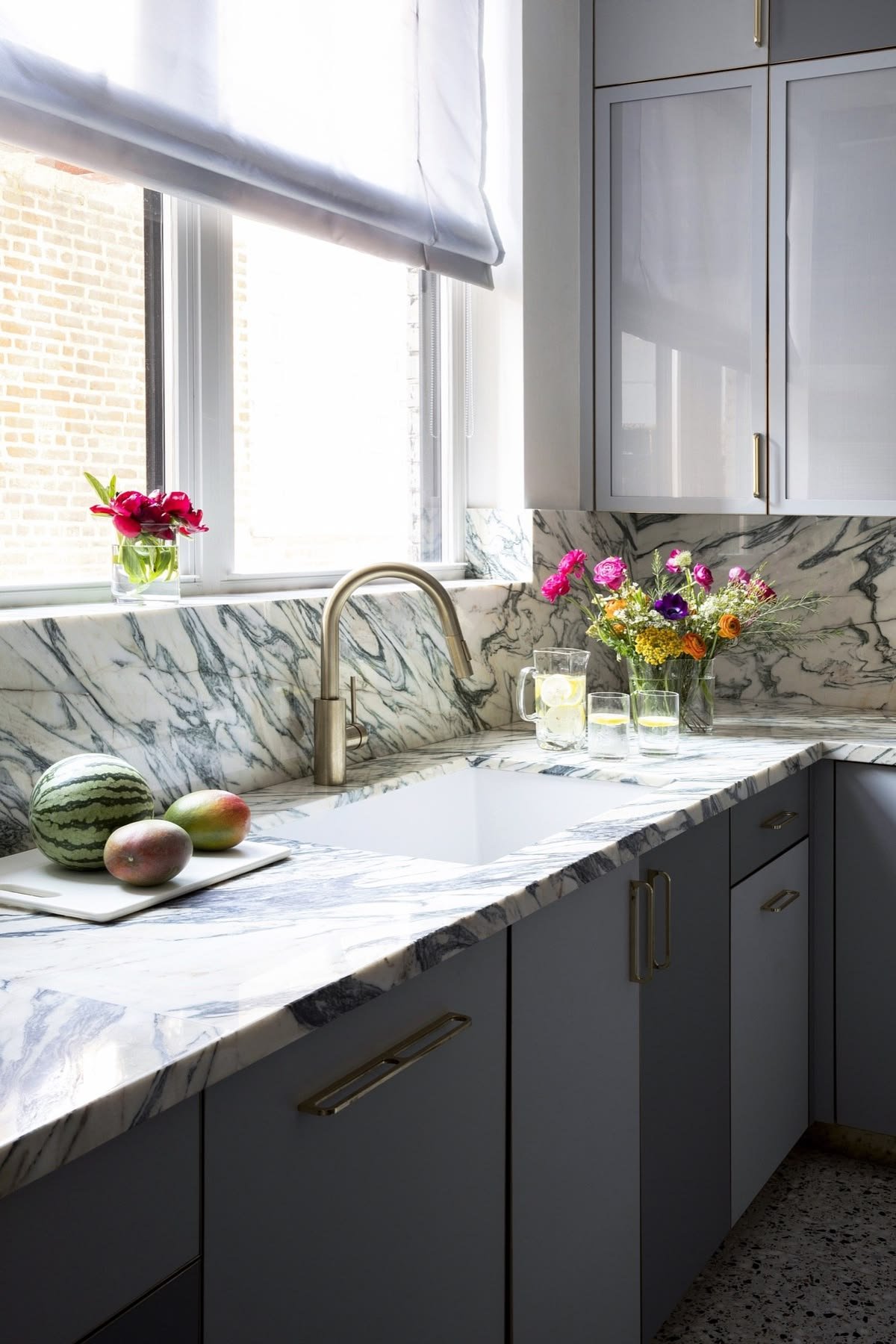
Kitchen by Fawn Galli Interiors
That kind of veining is not something a homeowner tires of the way they might tire of a trend color on the cabinets themselves. It reads as natural because it is, and natural things, marble included, rarely go out of style. Every slab is its own, which means the room built around it never quite looks like anyone else's either.
Quiet doors, confident hardware
The last piece is the one that's easiest to underestimate: hardware and profile. A simple, unfussy cabinet door, whether shaker or a plain flat panel, is close to impossible to date once it's installed. What keeps that simplicity from tipping into sterile is the hardware chosen to sit on top of it. A well-made pull in an aged brass or a soft, worn finish gives a plain door its personality, and unlike paint or stain, good hardware only gets better with a little wear. It's one of the only elements in a kitchen that genuinely improves with age rather than simply holding its ground.
Hardware is also the easiest piece of a kitchen to change your mind about later, which makes it a forgiving place to take a small risk. A door style, once installed, is a decade-long commitment. A pull or a knob is a much smaller one, and that's precisely why it's worth choosing something with real presence rather than something purely functional. The confidence can live in the hardware so the cabinetry itself doesn't have to carry it.
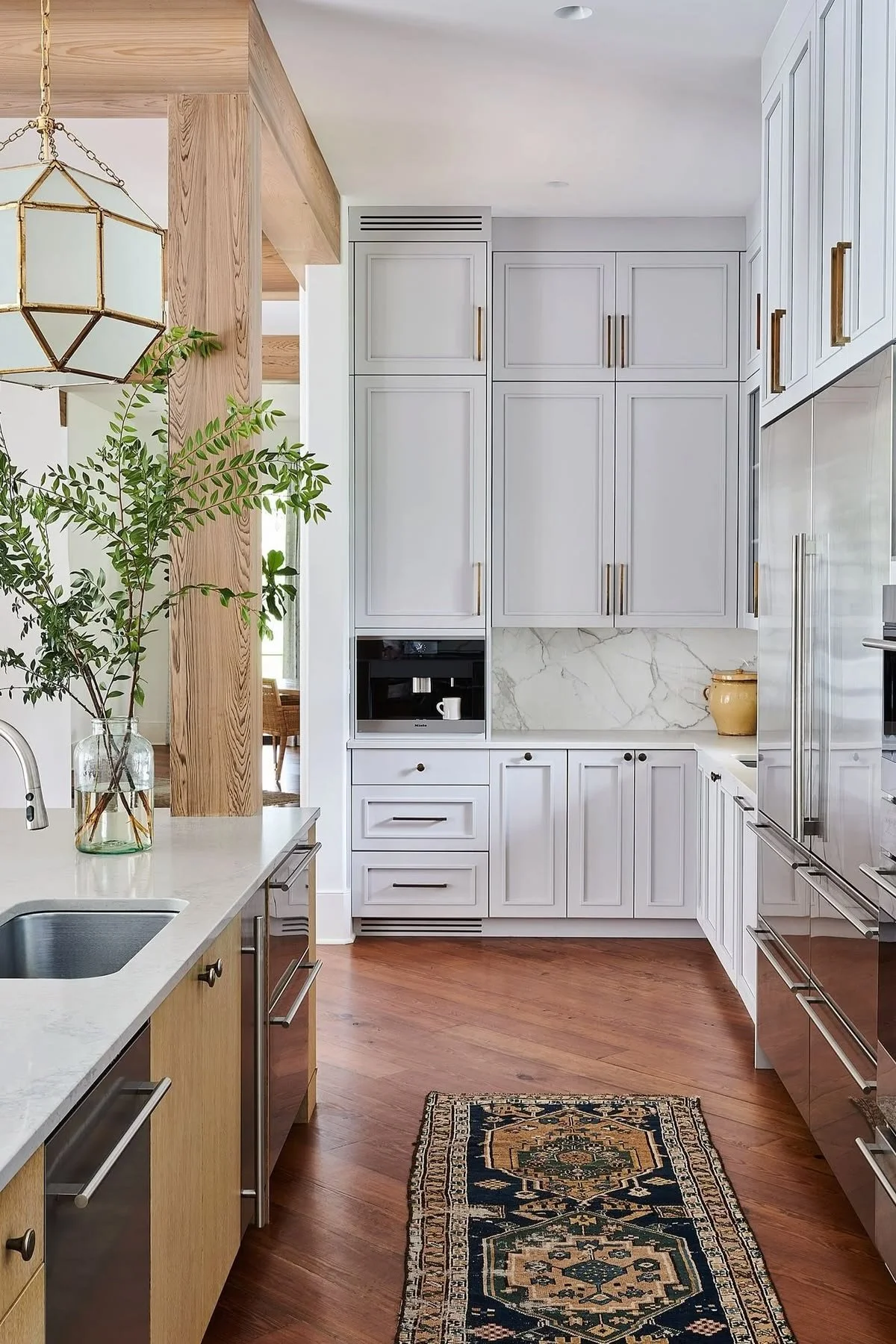
Kitchen by Logan Killen Interiors
Nothing about this kitchen is loud, and that's precisely why it works. The cabinetry is calm enough to let the floor, the vintage runner, and the hardware carry the character, and each of those elements is the kind that only grows more comfortable with age. It's a kitchen that will photograph just as well ten years from now, not because it was designed to chase a trend, but because it was never trying to in the first place.
The point of all of it
None of this is an argument for avoiding personality in a kitchen. It's an argument for finding that personality in the right place: in material that's honest about what it is, in stone that gets more interesting the longer you look at it, in hardware that earns its patina instead of just wearing out. A kitchen chosen this way rarely needs to be gutted because it fell out of fashion. It simply keeps aging the way good things do, quietly, and on its own terms, which is really the only kind of timeless worth aiming for.