
Mixing Antique and Contemporary Design: A Guide to Layering Old and New
A room built entirely from one era rarely feels like anyone's home. An all-antique room can read like a museum stage set, admired but untouched. A room furnished entirely new, however beautifully, can feel like it was purchased in a single afternoon and hasn't yet been lived in. The rooms that hold up over years, the ones a client still loves a decade later, are almost always the ones where something old and something new are asked to share the same space.
This is the part of the work I find most satisfying: taking a piece with real history, a chest that has already survived two centuries, a chair someone's grandmother sat in, and giving it a reason to belong next to something built last year. Neither piece should feel like an accessory to the other. The old piece isn't there for character and the new piece isn't there for comfort. Both are doing real work in the room.
Start with one piece, not a theme
The mistake I see most often is trying to design toward a look, "European eclectic" or "modern with vintage touches," rather than starting from an actual object. It works better in reverse. Find the one antique or vintage piece that earns its place on its own merits, and let the rest of the room be built around it.
In a cottage we worked on in Westchester, that piece was an antique oak island with turned legs and drawers worn soft at the edges, set down in a kitchen that is otherwise entirely of the moment: a terrazzo-look backsplash, cream Smeg appliances, clean oak counters. The island wasn't restored to look new, and it wasn't hidden behind newer cabinetry either. It sits in the center of the room as the oldest, most worked object in it, and everything else was chosen to let it stay that way.
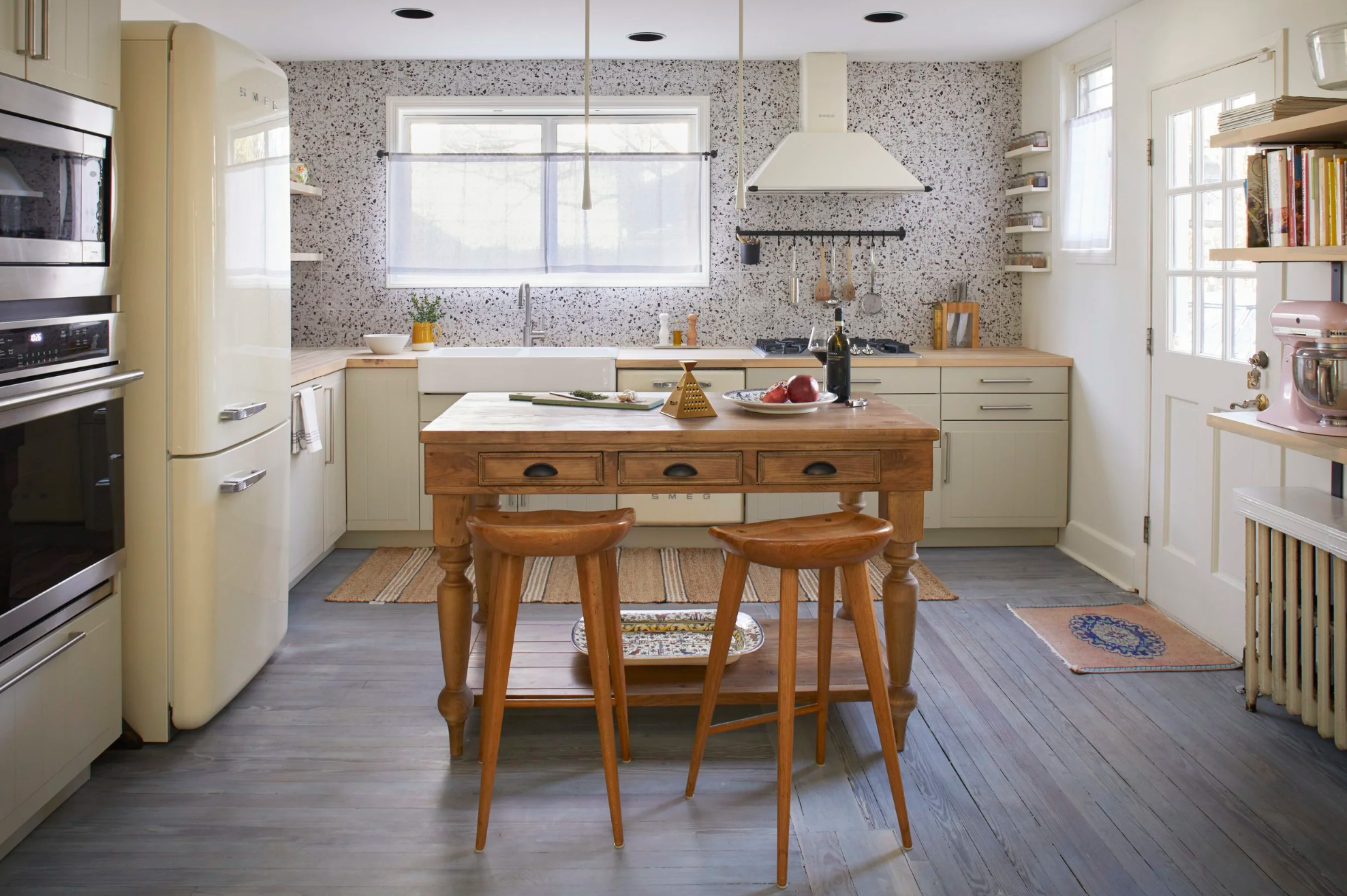
Cottage in Westchester
Let material do the bridging
Once an anchor piece is in place, the rest of the room needs something to hold it together with the newer pieces around it, and that something is almost never a matching style. It's a shared material, a repeated tone, a proportion that echoes across two very different objects.
In a Midtown Manhattan residence, the living room pairs a pair of sleek, low, contemporary sofas with a set of vintage bent-wood Jindrich Halabala armchairs, their dark curved frames doing quiet work against pale upholstery. Overhead the chandelier of vintage Italian Murano, soft blue-green glass with an aged patina, appears again elsewhere in the home. That repetition of the colorful accents of Murano glass vases and light fixtures throughout the apartment is what lets a lamp from decades ago sit comfortably beside a coffee table that could have been made yesterday. The eye recognizes the material before it registers the age.
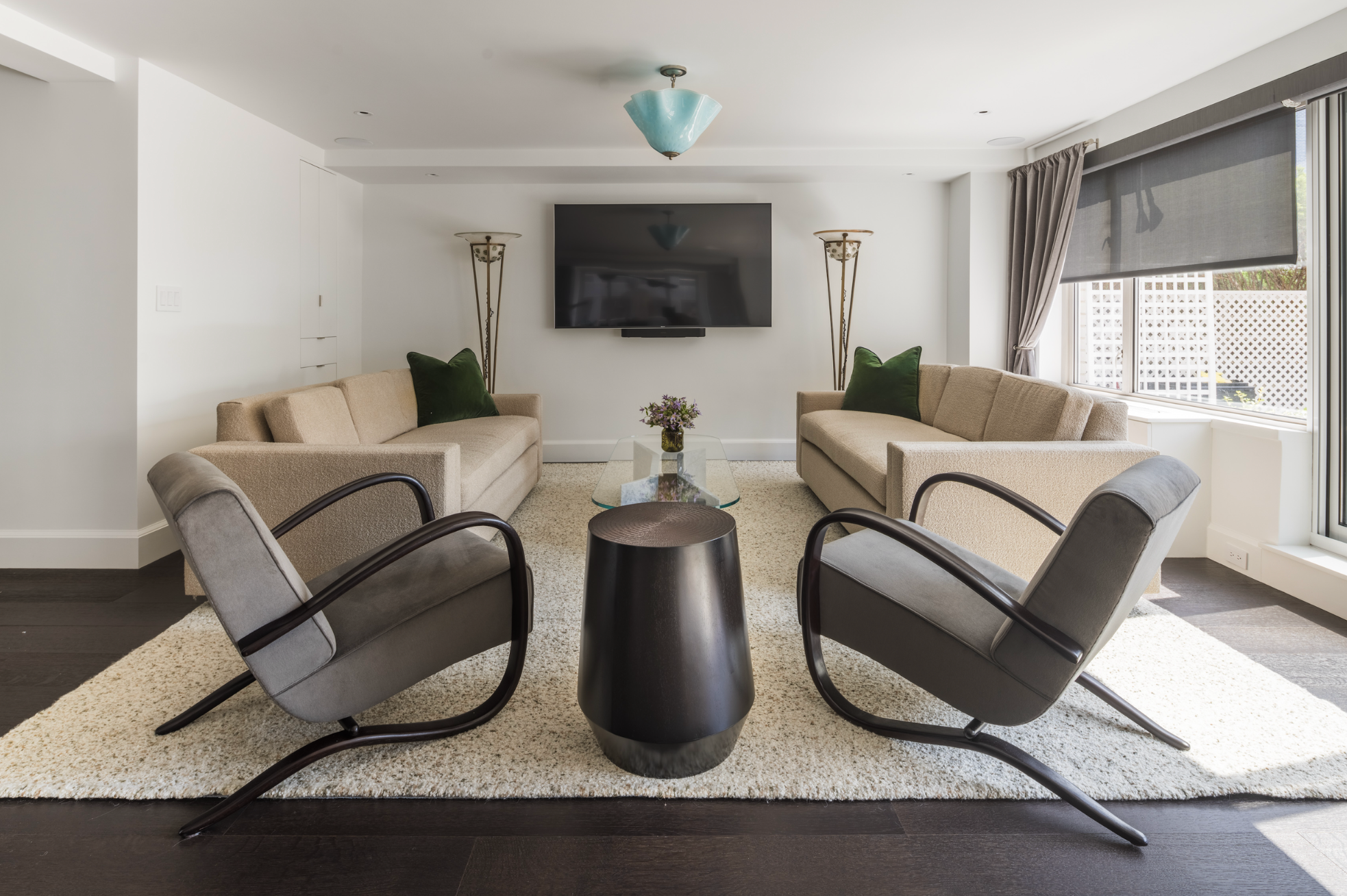
Midtown Manhattan Residence
Where the contrast should stay sharp
There's a temptation, once an antique piece is in the room, to soften it: reupholster the chair in the same fabric as the new sofa, refinish the old wood to match the new cabinetry, smooth over every difference until the piece stops looking old at all. Resist that. The tension between eras is the entire point, and softening it usually just makes both pieces look like they came from the same big-box order.
The same Manhattan apartment has a long hallway with a painting in soft grays and blue, deliberately worn and atmospheric, hung next to a dark, textured vintage mirror and a slim contemporary bench in woven fabric. Nothing there was chosen to match. The mural has age built into its very finish, the bench is unmistakably new, and the hallway works because each piece is allowed to look exactly like what it is.
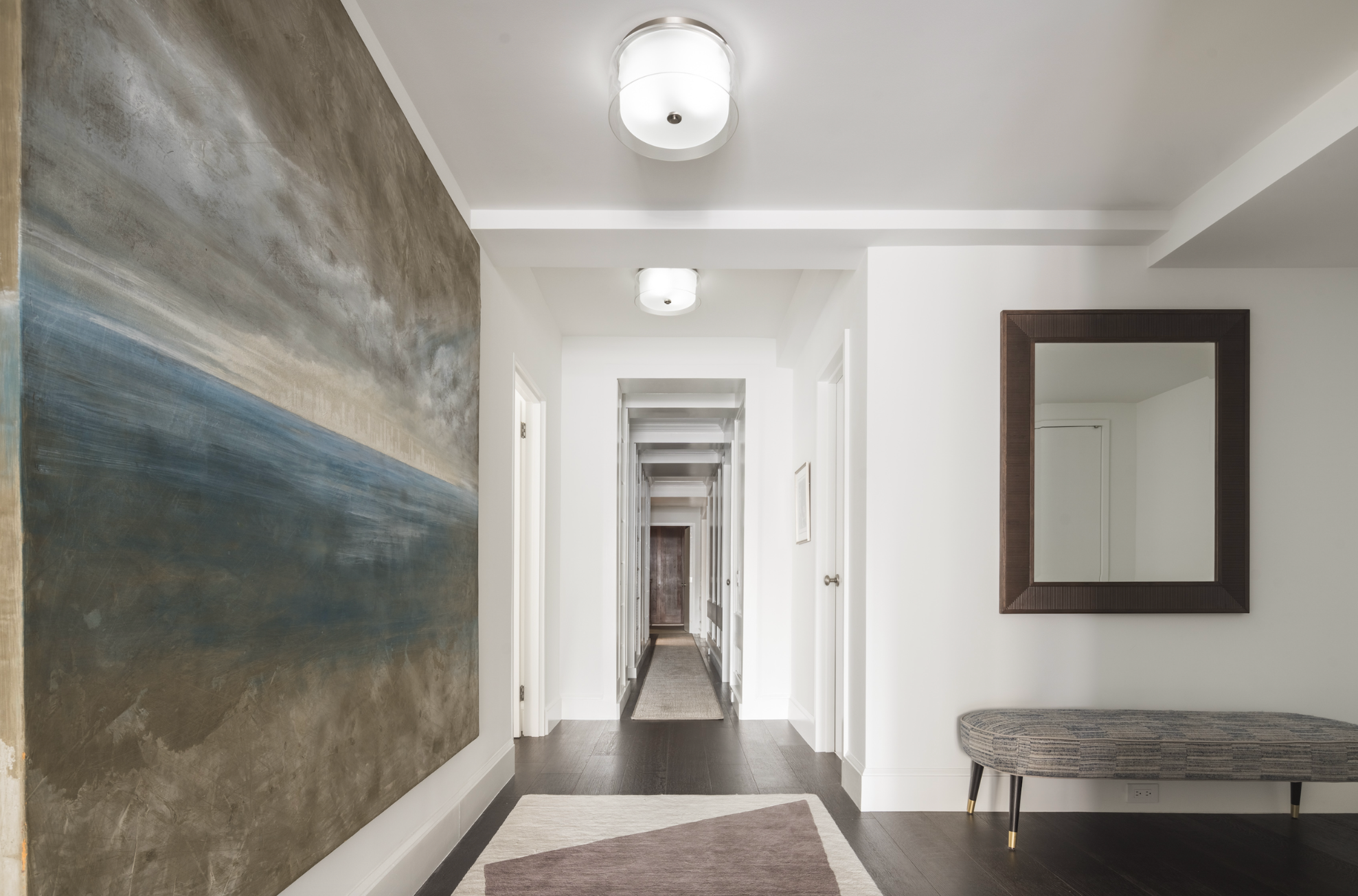
Midtown Manhattan Residence
An antique is already finished
There's a sustainability case for all of this too, though it's rarely the reason a client falls in love with a piece. An antique has already used up its resources. The wood was already grown and cut, the joinery already cured, the patina already earned through decades of actual use. Buying it and giving it a place in a new room is, in its way, the original form of sustainable design, long before the word existed. It asks for nothing new to be made. It only asks to be seen properly.
This is also why I'd rather source one real antique for a client than a dozen new pieces meant to look old. A reproduction can imitate the look of age, but it can't imitate the fact of it, and a room notices the difference even when the eye can't quite explain why.
A note on restraint
None of this works as a formula where a room gets one antique per new piece, evenly distributed like a place setting. The rooms that hold together have a few strong, considered pieces from each era and very little in between. Mixing periods isn't the same as mixing everything you own. It still takes the same editing a purely modern or purely traditional room would need, just applied across a longer span of time.
The goal isn't a room that announces its mix. It's a room where a two-hundred-year-old chest and a sofa delivered last month both look like they were always meant to be there, because in the room they've become, they were.